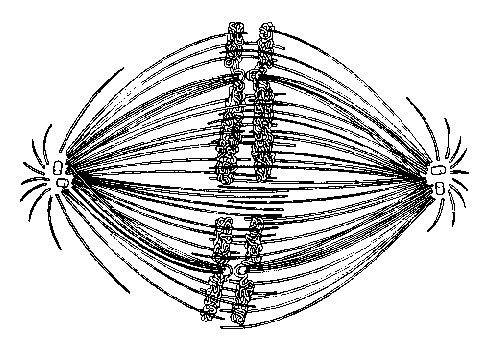
Figure 12.2
Exam
Name___________________________________
| MULTIPLE CHOICE. Choose the one alternative that best completes the statement or answers the question. | ||
| 1) | What causes the rhythmic change in cyclin concentration in the cell cycle? | 1) ______ |
| A) its destruction by an enzyme phosphorylated by MPF | |
| B) the cascade of increased production once its enzyme is phosphorylated by cdc2 | |
| C) the changing ratio of cytoplasm to genome | |
| D) an increase in production once the restriction point is passed | |
| E) the binding of PDGF to receptors on the cell surface |
| 2) | A cell that passes the restriction point will most likely | 2) ______ |
| A) show a drop in MPF concentration. | |
| B) undergo chromosome duplication. | |
| C) have just completed cytokinesis to separate into two new cells. | |
| D) stop dividing. | |
| E) move into prophase of mitosis. |
| 3) | Which of the following organisms does NOT reproduce cells by mitosis and cytokinesis? | 3) ______ |
| A) cow | |
| B) mushroom | |
| C) bacterium | |
| D) banana tree | |
| E) cockroach |
| 4) | Cytokinesis usually, but not always, follows mitosis. If cells undergo mitosis and not cytokinesis, this would result in | 4) ______ |
| A) cells with abnormally small nuclei. | |
| B) a cell with two or more nuclei. | |
| C) death of the cell line. | |
| D) feedback responses that prevent mitosis. | |
| E) a cell with a single large nucleus. |
| 5) | Regarding mitosis and cytokinesis, one difference between higher plants and animals is that in plants | 5) ______ |
| A) chromosomes become attached to the spindle at prophase, whereas in animals chromosomes do not become attached until anaphase. | |
| B) a cell plate begins to form at telophase, whereas in animals a cleavage furrow is initiated at that stage. | |
| C) sister chromatids are identical, but they differ from one another in animals. | |
| D) the spindles contain microfibrils in addition to microtubules, whereas animal spindles do not contain microfibrils. | |
| E) spindle poles contain centrioles, whereas spindle poles in animals do not. |
| 6) | How do the daughter cells at the end of mitosis and cytokinesis compare with their parent cell when it was in G1 of the cell cycle? | 6) ______ |
| A) The daughter cells have half the number of chromosomes and half the amount of DNA. | |
| B) The daughter cells have the same number of chromosomes and twice the amount of DNA. | |
| C) The daughter cells have the same number of chromosomes and the same amount of DNA. | |
| D) The daughter cells have half the amount of cytoplasm and half the amount of DNA. | |
| E) The daughter cells have the same number of chromosomes and half the amount of DNA. |
| 7) | Cells that have stopped dividing and are differentiating are | 7) ______ |
| A) in the M phase of the cell cycle. | |
| B) cancer cells. | |
| C) in the G2 phase of the cell cycle. | |
| D) in the S phase of the cell cycle. | |
| E) in the G1 phase of the cell cycle. |
| 8) | Measurements of the amount of DNA per nucleus were taken on a large number of cells from a growing fungus. The measured DNA levels ranged from 3 to 6 picograms per nucleus. One nucleus had 5 picograms of DNA. What stage of the cell cycle was this nucleus in? | 8) ______ |
| A) G2 | |
| B) G1 | |
| C) M | |
| D) G0 | |
| E) S |
| 9) | The formation of a cell plate is beginning across the middle of a cell and nuclei are re-forming at opposite ends of the cell. What kind of a cell is this? | 9) ______ |
| A) an animal cell in telophase | |
| B) a plant cell undergoing cytokinesis | |
| C) an animal cell undergoing cytokinesis | |
| D) a plant cell in metaphase | |
| E) an animal cell in metaphase |
| 10) | The centromere is a region in which | 10) ______ |
| A) metaphase chromosomes become aligned. | |
| B) chromosomes are grouped during telophase. | |
| C) chromatids are attached to one another. | |
| D) new spindle microtubules form. | |
| E) the nucleus is located prior to mitosis. |
| 11) | If cells in the process of dividing are subjected to colchicine, a drug that interferes with the functioning of the spindle apparatus, at which stage will mitosis be arrested? | 11) ______ |
| A) prophase | |
| B) interphase | |
| C) telophase | |
| D) anaphase | |
| E) metaphase |
| 12) | All of the following are characteristic of telophase of mitosis EXCEPT: | 12) ______ |
| A) Cytokinesis begins. | |
| B) Each chromosome is made of two chromatids. | |
| C) Astral microtubules disappear. | |
| D) Chromosomes begin to uncoil. | |
| E) The nuclear envelope reappears. |
| 13) | A cell containing 92 chromatids at the start of mitosis would, at its completion, produce cells containing how many chromosomes? | 13) ______ |
| A) 23 | |
| B) 46 | |
| C) 16 | |
| D) 92 | |
| E) 12 |
| 14) | During which phase(s) of mitosis do we find chromosomes composed of two chromatids? | 14) ______ |
| A) from G2 of interphase through metaphase | |
| B) from G1 of interphase through metaphase | |
| C) from interphase through anaphase | |
| D) from metaphase through telophase | |
| E) from anaphase through telophase |
|
Figure 12.2 | ||
| 15) | If the cell whose nuclear material is shown in Figure 12.2 continues toward completion of mitosis, which of the following events would occur next? | 15) ______ |
| A) spindle fiber formation | |
| B) cell membrane synthesis | |
| C) nuclear envelope breakdown | |
| D) centromere uncoupling | |
| E) chromatid synthesis |
| 16) | If there are 20 centromeres in a cell, how many chromosomes are there? | 16) ______ |
| A) 20 | |
| B) 10 | |
| C) 30 | |
| D) 80 | |
| E) 40 |
| 17) | All of the following occur during the latter stages of mitotic prophase EXCEPT: | 17) ______ |
| A) The nuclear envelope disappears. | |
| B) The centrioles move apart. | |
| C) The spindle is organized. | |
| D) The nucleolus disintegrates. | |
| E) Chromosomes are duplicated. |
| 18) | If there are twelve centromeres in a cell in G1 of the cell cycle, what is the diploid number of chromosomes? | 18) ______ |
| A) 12 | |
| B) 24 | |
| C) 48 | |
| D) 6 | |
| E) 36 |
| 19) | If the haploid number for a species is 3, each dividing diploid cell will have how many chromatids at metaphase? | 19) ______ |
| A) 6 | |
| B) 9 | |
| C) 12 | |
| D) 3 | |
| E) 18 |
| 20) | All of the following occur during mitosis EXCEPT | 20) ______ |
| A) the formation of a spindle. | |
| B) the degradation of the nuclear envelope. | |
| C) the synthesis of DNA. | |
| D) the division of centromeres. | |
| E) the coiling of chromosomes. |
| 21) | How many chromosomes will a cell have during mitotic anaphase if the diploid chromosome number is 4? | 21) ______ |
| A) 2 | |
| B) 4 | |
| C) 16 | |
| D) 8 | |
| E) 1 |
|
Use the data in Table 12.1 to answer the following questions. The data below were obtained from a study of the length of time spent in each phase of the cell cycle by cells of three eukaryotic organisms, designated beta, delta, and gamma. Table 12.1: Minutes Spent in Cell Cycle Phases  Cell Type G1 S G2 M  Beta 18 24 12 16 Delta 100 0 0 0 Gamma 18 48 14 20  | ||
| 22) | Of the following, the best conclusion concerning the difference between the S phases for beta and gamma is that | 22) ______ |
| A) beta is a plant cell and gamma is an animal cell. | |
| B) gamma contains more DNA than beta. | |
| C) beta contains more RNA than gamma. | |
| D) gamma contains 48 times more DNA and RNA than beta. | |
| E) beta and gamma contain the same amount of DNA. |
| 23) | The best conclusion concerning delta is that the cells | 23) ______ |
| A) divide in the G1 phase. | |
| B) contain only one chromosome that is very short. | |
| C) are actually in the G0 phase. | |
| D) contain no RNA. | |
| E) contain no DNA. |
| 24) | The S phase was measured by | 24) ______ |
| A) counting the number of cells. | |
| B) synthesis of the S chromosome. | |
| C) determining the start and stop of increased DNA in the cells. | |
| D) stopping G1. | |
| E) synthesis versus breakdown of S protein. |
| 25) | Enzymes that control the activities of other proteins are called | 25) ______ |
| A) protein kinases. | |
| B) ATPases. | |
| C) microtubules. | |
| D) kinetochores. | |
| E) chromatin. |
| 26) | Proteins that are involved in the regulation of the cell cycle, and that show fluctuations in concentration during the cell cycle, are called | 26) ______ |
| A) proton pumps. | |
| B) centrioles. | |
| C) kinetochores. | |
| D) cyclins. | |
| E) ATPases. |
| 27) | Colchicine is a drug that binds to the protein that forms microtubules, thereby preventing microtubules from forming. Colchicine has been used to study mitosis because it stops the process. Most likely this is due to | 27) ______ |
| A) prevention of cell-plate formation. | |
| B) prevention of kinetochore formation. | |
| C) alteration of centriole structure. | |
| D) prevention of sister chromatid formation. | |
| E) inhibition of DNA synthesis. |
| 28) | Which of the following is NOT true of the bacterial chromosome? It | 28) ______ |
| A) is associated with proteins. | |
| B) floats freely inside the bacterial cell. | |
| C) is highly folded within the cell. | |
| D) contains a single, circular DNA molecule. | |
| E) has genes that control binary fission. |
| 29) | A cell with 20 chromosomes (diploid number) goes through the cell cycle. The number of chromosomes after doubling the DNA in the S phase is | 29) ______ |
| A) 20. | |
| B) 10. | |
| C) 40. | |
| D) called haploid. | |
| E) called the S number of chromosomes. |
| 30) | Taxol is an anticancer drug extracted from the Pacific yew tree. In animal cells, taxol disrupts microtubule formation by binding to microtubules and accelerating their assembly from the protein precursor, tubulin. Surprisingly, this stops mitosis. Specifically, taxol must affect | 30) ______ |
| A) the S phase of the cell cycle. | |
| B) the fibers of the mitotic spindle. | |
| C) formation of the centrioles. | |
| D) chromatid assembly. | |
| E) anaphase. |
| 31) | A cell is just beginning the S phase of the cell cycle. It is fused to a cell in metaphase of mitosis. Which of the following best describes what would happen to the nucleus of the first cell? | 31) ______ |
| A) It would stop DNA synthesis and immediately divide, with essentially no G2. | |
| B) It would continue to complete S, have a short G2, and then divide. | |
| C) It would stop DNA synthesis, undergo a relatively normal G2, and then divide. | |
| D) It would immediately stop S and enter G0. | |
| E) It would continue to complete S, have a normal G2, and then divide. |
| 32) | Which of the following is NOT analogous to the "checkpoints" that control cell division? | 32) ______ |
| A) the use of a magnetic reader to verify a credit card | |
| B) the use of a user ID and password to access a computer account | |
| C) the use of a telephone number to call home | |
| D) the use of a PIN to get money from an ATM | |
| E) the "checkpoints" at a military base that control the movement of people in and out of the base |
| 33) | As the cell progresses through prophase and into metaphase, the level of active anaphase-promoting complex proteins | 33) ______ |
| A) is initially high, but drops precipitously when all the chromosomes are lined up in metaphase. | |
| B) remains constant. | |
| C) decreases gradually. | |
| D) is initially zero and increases sharply once all the chromosomes are lined up in metaphase. | |
| E) increases gradually. |
| 34) | A mutation results in a cell that no longer produces a normal protein kinase for the M-phase checkpoint. Which of the following would likely be the immediate result of this mutation? | 34) ______ |
| A) The cell would undergo normal mitosis, but fail to enter the next G1. | |
| B) The cell would never leave metaphase. | |
| C) The cell would never enter prophase. | |
| D) The cell would never enter metaphase. | |
| E) The cell would prematurely enter anaphase. |
| 35) | "Density-dependent inhibition" is explained by which of the following: | 35) ______ |
| A) As cells become more numerous, the amount of required growth factors and nutrients per cell becomes insufficient to allow for cell growth. | |
| B) As cells become more numerous, the level of waste products increases, eventually slowing down metabolism. | |
| C) As cells become more numerous, they begin to squeeze against each other, restricting their size and ability to produce control factors. | |
| D) As cells become more numerous, more and more of them enter G0. | |
| E) As cells become more numerous, the protein kinases they produce begin to compete with each other, such that the proteins produced by one cell essentially cancel those produced by its neighbor. |